Tuesday, February 03, 2009

Africa for Obama

Tuesday 20 January 2009

About 67 million people actually cast a ballot for him but for hundreds of millions more today is a historic day. He may have been voted President of the United States of America only but over here in Tanzania it certainly feels like Barack Obama has been anointed the leader of the united nations of Africa too. I can only imagine what it must be like in neighbouring Kenya but over here the Obama-mania is thick enough to cut with a knife. Everywhere you look you can see Obama bumper stickers, Obama shirts and shawls, and buses decorated with "yes, we can".

It is hard not to be swept away by all the enthusiasm and I too of course recognise the significance of this day. Rather than watch the inauguration ceremony all alone on CNN in my hotel room, I decide to join the crowds in the bar. Although there is still almost an hour to go before the supreme moment, it is already very crowded. I suddenly find myself wedged on a sofa between an American woman and her Tanzanian companion. The three of us each represent a different continent and we each have our own reasons to be excited by this moment but the feeling is equally intense in all of us. Together we watch the moment when Barack Obama is sworn in as the 44th president of the USA. Together we briefly draw our breath when it seems he stumbles over the most momentous words of his life. It is not until the next day—away from the bar clamour—that I learn the mistake was not his but was prompted by the bumbling Chief Justice. It does not matter. All this crowd cares about is that as of this moment Barack Obama is the new president; not just America's but Africa's too.

Return to the light

Monday 19 January 2009

December is not my month. Call it holiday blues, call it winter depression, call it whatever you like but December just really is not my month. All I want to do is fast-forward the year to its inevitable conclusion and start fresh. January is better. Maybe it is the illusion of the blank slate, maybe it is the slow lengthening of the days but January inspires me to look forward rather than backward. Before me now is a new adventure: two weeks of field work in Tanzania. Over the next 14 days I will be working both in Dar es Salaam and in the Northern parts of the country.

I have been to Dar before—less than half a year ago—so naturally my arrival here has had a slight déjà-vu feel to it: the prerogative of the returning traveller. I am even staying at the same hotel I did last time and recognise some of the faces of people working here. The temperature is equally familiar. So near to the equator defining seasons as "winter" or "summer" is pointless. Strictly speaking I have moved from the European winter to an African summer but I can't really tell the difference with my last visit here when the situation was reversed. It was hot then as it is hot now.


After a productive first working day, I fall back into a routine I established during my previous visit and wash away the city dust in the hotel pool. After weeks of darkness and inactivity, I feel reinvigorated by the light and excitement. The new year is off to a good start.

Resuscitation

For a variety of reasons this blog has been in deep hibernation for a while. In fact, I had every intention of letting it sleep all together after two years of service. However, over the last weeks and months several people have lamented this decision and have urged me to reconsider. It is for them that I will attempt to breathe some life into the old girl once more. Forgive her for waking up a bit groggy still.

Plenty of things have changed since my last post; even more things haven't. I am still living and working in Amsterdam though that situation is set to change before winter's end. Over the holiday season my suitcase has been sharing shelf space with this blog. The arrival of the new year, however, has had me dust it off to pack for Tanzania again. Although—as we say in Dutch—this might come a bit as "mustard after the meal", over the next few days I will attempt to share some of my experiences there with you in words and images.

We have a pulse...

Monday, November 10, 2008

My city secret

My dear friend MyYear has tagged me through her blog to share my Amsterdam "city secrets" with the world. I have been thinking long and hard about this and have found it is not easy for me to come up with something.

When is a secret really a secret? It took me years of living in Amsterdam before I discovered that the nearby Park Frankendael is in fact a lovely place for a Sunday stroll. Most likely this was not a secret to all the other people in the Oost-Watergraafsmeer area but it was to me. I have not yet had a chance to eat there but the glass house based restaurant in the park was high on the list of potential party places for my thesis defense. Too bad that it would have shattered the glass ceiling on my budget. Is it a secret if that cute little Italian restaurant I like is often so full that there is barely a table available? And how could the country's most famous movie theatre qualify as a secret? No, many of my favourite places are no secrets.

The best places in this city for me are the best not by their virtue of being a secret but because of the memories I have there: that first-date café with a name that will certainly trip up anybody non-Dutch or non-sober, the dinner-and-a-movie place where my dad and I sat and talked for hours, the restaurant where a multi-national group of us played multi-lingual scrabble and of which I sadly was unable to commit the name to memory. None of these are secrets in the sense that they are little known must-go-to places. They are just part of the mosaic of my life in Amsterdam, the city I hold so dear. And that is no secret.

Sunday, October 12, 2008

The Village Petstore and Charcoal Grill

Guerilla artist Banksy strikes again with a wonderfully hilarious rendition of the relationship between animals and humans. A fake petshop in the Village in New York is full of weird "animals", such as fish fingers in a bowl, little baby chicken nuggets, and a family of hotdogs. Who knew a sausage could look so cute!

This little white rabbit is one of my favourites:


Friday, October 10, 2008

eXtremely dangerous

Sometimes a picture is worth a thousand words.

Monday, October 06, 2008

Lady of the Lake

In a week's time I experienced the two extremes of the hospitality spectrum. On the one hand there was the Moscovian hotel that treated us like annoying nuisances with silly requests such as clean bedding and less than Arctic room temperatures. On the other hand there was the amazing service offered at last week's equally priced but far more comfortable Genevois hotel where WiFi, travel adaptors and even umbrellas were provided courtesy of the hotel. I was on a pelgrimage to this Mecca of global health for a project meeting. The wonderful hospitality was a great introduction to the city but hospitality alone is of course not enough. Geneva gets measured by a different yardstick. That is, the yardstick of "could-I-live-here?".

I was prepared to be a little depressed by Geneva. Several of my colleagues have lived there and had warned me that although "great for families with kids" the city is on the dull side. Fortunately, I found that although it may not have the buzz of London or Amsterdam, there is a lot to be said for this city. After having lived in London, the obvious pricyness of Geneva does not really scare me so much anymore. It is not just the hotel staff that is friendly and helpful either. It has been a while since I was anywhere where motorists stop to let a pedestrian cross without even an authorised crossing in sight! Sure, there are no canals but that lake is pretty impressive too! Cheese fondue is high on my list of favourite things to eat and best of all of course: o those mountains! As a self-professed snow-aholic the sight of snow on the mountains gets me pretty psyched up. It has been far too long since I have been able to take a holiday and enjoy the slopes so the idea of living somewhere where that can be done as a weekend break is exciting.

So the verdict on the question of "could-I-live-here?"? Well, it's not Amsterdam and it never will be but yes, I think I could. That is, provided of course that the city is not the first to get sucked into that black hole.

Tuesday, September 30, 2008

Stairway to heaven

Other than the friends I left behind in the UK, there are not that many things that I really miss about my life in London. That does, however, not mean that there are not a few areas where I have always felt the Dutch could stand to learn a lesson or two from their overseas neighbours. Escalator etiquette is one of those things. Anyone who has tried public transport commuting in the Netherlands and who has had to dash for that connecting train will know what I mean. We Dutch just like to stand all over the place, dead set on thwarting all those who try to survive in the fast lane. The simple concept of "walk left, stand right" is lost on us. Until now...

Yesterday morning I arrived at the station of my native Amersfoort. To my surprise I found the escalators there had been decorated with bright green and red footprints, teaching us silly Dutch how to behave on an escalator! Apparently it is part of a 'pilot project' and Amersfoort has been lucky enough to get the premiere. Believe it or not but it even came with a crash course in elevator walking. It seems we are just THAT stupid. Well, I hope it works. What's next? Allow me to make a suggestion: could we please send the Amsterdam taxi drivers to learn from their London black cab colleagues?

Monday, September 29, 2008

Good bye Lenin!

For the last week I have been in Russia once again. The whole trip had a significant déja-vu feel as essentially it involved the same people and places as it did last time. The Red Square and Kremlin are still impressive the second time around but at the risk of sounding a bit blasé: been there - done that. Even the weather greeted me like an old friend as the familiar rains poured down once more on Saturday. Fortunately I had allowed myself one extra day at the end of my stay and on Sunday the Indian Summer showed itself, even if it was shy. It gave me the opportunity for ticking off some of the boxes left on my what-to-see-when-in-Moscow list.

First up was the New Tretyakov gallery, the big brother to the other Tretyakov gallery I had visited last time. The New Tretyakov houses 20th century Russian art and in all fairness was far more to my liking than the icons and classic Russian paintings on display at its sibling. Particularly the avant garde paintings of artists such as Aristarkh Lentulov or Kazimir Malevich were in my opinion highly worth seeing. The collection of socialist art, full of propagandist glorification of peasants and labourers, was also quite interesting. Unfortunately about half of the museum was closed for renovations but since I had already been marvelling around for close to two hours by the time I reached those sections, I could not really be too disappointed.

Just outside the museum is another little gem: the Sculpture Park. Once apparently known as the "Park of Fallen Heroes", it is home to a collection of statues that in Soviet times adorned the city's squares and monuments. After the fall of communism the countless busts of Lenin, Stalin and the likes were relocated to this park where they now share the limelight with a more colourful collection of somewhat random sculptures. Especially powerful -particularly due to its juxtaposition to a life sized figure of Stalin- was an installation composed of dozens of sculpted faces packed behind barbed wire, thus remembering the victims of Stalin's labour camps.


After this trip my Moscow-to-do list has gotten another bit shorter. Of course there is always plenty left but frankly, I hope next time they'll send me to St. Petersburg instead!

All pictures

Wednesday, September 17, 2008

Raise the red lantern

When 2 of my favourite cities meet, THIS is what you get?! O dear... so much for me ranting about how Amsterdam is more than just the red light district.

Art in the glow of Amsterdam red lights
Gallery hopes 'canal of the whores' will connect with more traditional works

By: Charlotte Higgins
The Guardian, Wednesday September 17 2008

Never have its gracious enfilades and echoing halls witnessed anything like it: the National Gallery, repository of the nation's finest Old Masters, is to re-create a red-light district, complete with scantily clad prostitutes, sinister alleyways and shop windows filled with human wares. This walkthrough installation is Ed and Nancy Kienholz's work Hoerengracht - Dutch for "whores' canal" - which will take its place in the gallery next autumn.

The idea is to make connections with the Dutch 17th-century paintings in the gallery's collection, which, despite their appearance of gentility, are set in the brothels for which Amsterdam is famous. Paintings such as Jan Steen's Interior of an Inn, Schalcken's A Man Offering Gold and Coins to a Girl and De Hooch's Musical Party in a Courtyard will be hung near the entrance to the installation, which the Kienholzes created in the 1980s.

The New York Times has described the effect of Hoerengracht thus: "In excruciating detail, a woman washes herself at a grungy sink; another, more scantily clad, sits in a chair scanning a magazine amid the kitschy trappings of her cubicle ... Still another professional, in leopardskin pants, high boots and a sequiny top, stands poised in a doorway behind an iron grille, mouth open in a sexy pout, fingers holding a cigarette."

Asked whether the installation would carry a warning for families, Colin Wiggins, the National Gallery's head of education, said: "In the paintings of De Hooch there are dodgy things going on, but we don't put warnings outside our Dutch 17th-century rooms. "Our aim is to stop people in their tracks and make them think, 'Crikey, this is unprecedented for the National Gallery.' Would you warn your child against it? Well, it depends who you are. Sarah Palin would probably warn her children. But we have Soho just down the road where you can see young ladies in leopardskin miniskirts."
Read more
(
Picture: 'Hoerengracht' (detail of street corner with photo montage and mannequin), 1984-88 by Ed and Nancy Kienholz)

Saturday, September 06, 2008

Healthy world

I must admit I haven't used my constitutional right to vote in a while. I suppose you could say that I have been hiding my voter apathy behind the rather flimsy excuse of living abroad. On top of that, the Dutch political landscape is just so depressing these days with parties such as the ominously titled "Trots op Nederland" (Proud of the Netherlands) and "Partij voor de Vrijheid" (Party for Freedom) that I'd rather run for the hills than participate in this sham. Not the way to go, I know. I'll try to do better in future. You've got to practice what you preach after all, and I'm certainly no stranger to a bit of political preaching. One of my former flatmates once sighed in desperation "Are all you Dutch so political?!".

A lot of my preaching takes places in the international rather than the domestic arena, probably in part the result of my line of work these days. Like so many across the world, I have been keeping a very close eye on the US presidential elections. And like so many outside of the US, I have had no trouble picking my favourite. Of course, healthcare is a topic close to my heart in this election. The American healthcare system represents both some of the best and worst in the world. Top class medicine for some but unattainable for many. In international aid and development on health, the Americans have also imposed an at times rather controversial agenda. It is interesting to see where the candidates stand on these issues. If I hadn't made up my mind already, this article just published in The Lancet might have done it for me:
Obama vs McCain on global health
by: Nellie Bristol
The Lancet (2008), 372:9638, p.521-522

In the run-up to the presidential election, US health care continues to dominate the debate. But where do the candidates stand on global-health issues? Nellie Bristol reviews Obama and McCain's pledges in this area, including their views on HIV/AIDS and international development.

When asked by a reporter last year if he supported the spending of US tax dollars on contraceptives in Africa to slow the spread of HIV/AIDS, John McCain, the Republican US presidential hopeful, seemed unsure and confused. "I haven't thought about it before", he said. "Before I give you an answer, let me think about it a little bit because I never got a question about it before. I don't know if I would use taxpayer money for it."

The scene illustrates what global-health experts say is the key difference between McCain and Democratic contender Barack Obama in the area of global health: that of particular investment in the issue. "Obama has a personal knowledge and interest that is not insignificant", said J Stephen Morrison, executive director of the HIV/AIDS task force and of the Africa programme for the Center for Strategic & International Studies, based in Washington, DC. "He made sure he was smart around the issues of global health." Morrison cited Obama's Kenyan father and his August, 2006, visit to Africa where Obama and his wife Michelle were publicly tested for HIV/AIDS in an attempt to reduce stigma attached to the procedure. "I do not think McCain is indifferent, but I do not think he has the same level of personal knowledge or passion", Morrison said. "[McCain has] said much less both about development issues and global health so it's hard to infer from silence", said Ruth Levine, vice president for programmes and operations and senior fellow at the Center for Global Development (CGD). "It does not feel like a core part of the agenda he would bring in."

That difference is evident in the candidates' campaign literature and in their statements about global health. Although McCain is a vocal supporter of the US global AIDS programme—the President's Emergency Plan for AIDS Relief (PEPFAR)—and has pledged to combat malaria in Africa, his campaign documents are thin on the subject of global health. Meanwhile, Obama's campaign promotes proposals to confront HIV/AIDS globally and has a multiple page list of sweeping reforms in international development. "He is really reading the play book of many of the strongest voices in development and in global health", Levine commented. Obama supports and calls for changes in PEPFAR, including an additional $1 billion over 5 years to fight the epidemic in southeast Asia, India, and eastern Europe. He also calls for increasing the capacity of health systems to deliver HIV/AIDS treatment. In a move likely to cost him support among pharmaceutical manufacturers, Obama also pledges to "break the stranglehold that a few big drug and insurance companies have" on HIV/AIDS drugs. "Obama supports the rights of sovereign nations to access quality-assured low-cost generic medication to meet their pressing public health needs", his campaign literature says.

Although supporting US bilateral HIV/AIDS efforts, Obama also advocates more US funding for multilateral programmes and the Global Fund to Fight AIDS, Tuberculosis and Malaria. US support for the Fund has been a partisan issue; some conservatives are concerned that the organisation does not reflect US policies on issues like sexual abstinence and needle exchange. Obama also pledges US support to meet the UN Millennium Development Goals. In 2005, he cosponsored the International Cooperation to Meet the Millennium Development Goals Act.
Some Americans view the UN suspiciously, and even hostilely, claiming its aim is to usurp US power and channel money to corrupt dictators. The USA is behind in its payments to the organisation and many, including Obama, are pushing for UN reforms. Nonetheless, development experts say his endorsement of the goals and of other multilateral efforts is substantial, indicating a change from the go-it alone strategy now used by the USA. "It is quite a profound departure from what we have seen up to this point", said Levine. "I think it will really bring US development policy into alignment with where Canada and the Europeans have been."

Another key piece of Obama's development platform is his Health Infrastructure 2020 plan. "Barack Obama will take the lead at the G8 working with and leveraging the engagement of the private sector and private philanthropy, to launch…a global effort to work with developing countries to invest in the full range of infrastructure needed to improve and protect both American and global health", campaign documents say. Among issues addressed by the plan is the migration of health-care workers from developing to rich countries. Obama also advances sweeping reforms for US foreign assistance—a move favoured by the development community and some members of Congress. He advocates doubling yearly foreign assistance to $50 billion by 2012 and endorses a $2 billion fund to support primary education globally. He also calls for 100% debt cancellation for the world's heavily indebted poor countries and programmes to advance commerce and democracy in struggling countries.

Add it all up and the dream plan of Obama's development experts costs a substantial amount of money, so much so that some question its feasibility. "It is not entirely clear to me that everyone has done their homework on how this could possibly be paid for in what is sure to be a real food fight around priorities in a tight economy", said CGD's Levine. In addition to fiscal constraints, because he is so engaged with the global development community in the USA, Obama is also likely to be buffeted by the tensions that exist within it, Morrison added. One major point of contention is the degree to which PEPFAR will become the whole of the USA's global-health policy for the foreseeable future. "What he [Obama] has is a very active and divided debate" with one side arguing that PEPFAR has had "hugely distorting impact on development commitment", he said. Those advocates will be "arguing for a rebalancing" against the constituency that believes PEPFAR can be tweaked sufficiently to serve a broader purpose. "I would anticipate that early in an Obama administration you are going to have some serious battles around these issues", Morrison commented.

Nils Daulaire, president of the Global Health Council, although a strong PEPFAR supporter, is among those who think that the USA should widen its focus. "The reality is that HIV/AIDS is a large, but by no means the predominate piece of the global-health puzzle", he said. The Global Health Council and others, he said, are "really focused on getting the next Presidential Administration and the next Congress to look at the larger issues of global-health infrastructure and basic health services and, in particular, bring back attention to the pretty severely neglected areas of maternal and child health and family planning."

Although global-health experts call for increased access to primary health care, specific diseases still tend to attract the most attention from candidates. On Malaria Awareness Day, McCain pledged as President to "end malaria in Africa". He said that the USA will spend $1 billion a year on the disease in the next few years and added, "I call upon the private sector to meet its obligation to serve a cause greater than its self-interest by matching the federal commitment dollar for dollar". Laurie Rubiner, executive director of the Malaria No More Policy Center, said eliminating deaths from malaria in Africa, would cost an estimated $2·2 billion a year over 5 years. The disease currently kills more children in Africa than AIDS and tuberculosis combined, she added. McCain's malaria pledge illustrates his commitment to "soft power" in US foreign policy, Rubiner commented. Another example of that approach is McCain's proposed "League of Democracies", which he refers to as "the core of an international order of peace based on freedom". In explaining the proposal, McCain said, "Our great power does not mean we can do whatever we want whenever we want, nor should we assume we have all the wisdom, knowledge, and resources necessary to succeed". He added: "We need to listen to the views and respect the collective will of our democratic allies."

Experts agree that both candidates support a more collaborative relationship with other countries, which could be a boon for global health generally. "Both Obama and McCain from quite different perspectives have an appreciation for the US in the broader context of the world", said Daulaire. "I think this is the most internationally savvy pair of candidates that we have ever had running for president."

Going Dutch

It's not been quite a week yet but steadily I am beginning to get settled back in into my Amsterdam life. So many things are still the same that at times it is as if I have never left. The shops I knew are all still there, I even recognise plenty of faces in the neighbourhood and much of Amsterdam is still in its by now familiar construction chaos. Still, there are a few things in my own habits and behaviour that are subtle reminders that I have been away for quite a while. I need to learn to look the other way again when crossing a street. I need to remember again to say my own name first when answering the phone. I need to go back again to using the magnetic strip on my bank card rather than the chip. I need to use a strippenkaart again, not an Oyster card. I need to start yelling at cyclists who nearly run me down again, instead of saying "Pardon me". I need to become that cyclist again, not the silly pedestrian. In short, I have to work on my 'inburgering'.

There is one change in the neighbourhood, however, that suddenly made me feel that perhaps I have taken a piece of the UK with me to Amsterdam. The squatted house around the corner suggests Banksy has gone Amsterdam too:

Tuesday, September 02, 2008

The eagle has landed

Here I am: back in Amsterdam! It has been a long couple of days. On Saturday I went to meet my mother in Dover to drive to London together. It actually took me leaving the UK to travel beyond the confines of the M25 [with slight exceptions for trips to Oxford and Cambridge]. Sunday was a particularly long day. My London apartment was situated on the third floor and unfortunately did not come with a lift so we had to carry all those boxes down those 60-something steps. With a fully loaded car we then spent about 9,5 hours on the road, travelling all the way back to the Netherlands. Three cheers for my brave mother for doing all this for me: hurrah, hurrah, hurrah!!

I was quite anxious to see my apartment again and to see how it had weathered out the storms of 2 years of tenancy. It turned out to be more Gustav than Katrina. There is no major damage of any kind, just the usual wear and tear that comes with habitation. Two years of alien occupation have, however, left their fair share of grease and grime everywhere. For the last two days we have been working on giving the place the deep clean it desperately needs, removing the mould from the fridge, busting the grime from the shower tiles and vacuuming up the smelly cigarette buds behind the bed. Slowly but steadily the place I know and love is starting to shimmer through again.

Not all my boxes are unpacked yet. In fact, not all boxes are retrieved from storage yet. Since I will be working from home for the next few months I intend to convert the guest room into a proper study (though guests will still be welcome and need not worry about having to sleep on the floor!). This means some serious reshuffling of furniture; moving the desk, shelves and bookcases around. As soon as that is done I will collect and unpack the rest of my stuff and will well and truly put my house in order. My only slight concern at this point? That I may have to do all this again in a few months time... sorry mum!

Friday, August 29, 2008

A picture is worth a thousand words

The fairly wobbly (and massively overpriced) internet connection at my Tanzanian hotel meant that I had not yet had a chance to upload all my pictures. For those of you who want to see more of the Zanzibari sunset, the Tanzanian tingatinga art, or Africa's pick for the American presidency, you can now have a look here:
Tanzania 14-26 Aug 2007

Thursday, August 28, 2008

It's the final countdown

Barely back from Tanzania I am preparing once again to pack my bags. Or rather, to pack my moving boxes. In 3 days from now I will be back in the country where the trains are yellow, the cows black and white and the royals Orange.

Since my arrival here almost two years ago, the original collection of my local belongings has expanded from a single suitcase to a room full. Getting everything to the other side of the Channel proved either a logistical or financial nightmare or both. Carrying things with me by plane was a definite no-no. Too much stuff, not enough luggage allowance. Going through a shipping company was no option either. Too expensive. Royal Mail might be cheaper but errr... let's say I value my belongings too much and I'd like to see them again. This decade preferably. Fortunately there is always super-mom to the rescue! She has graciously offered to drive all the way here to London to collect me and my belongings. Of course I suspect she just wants to make sure I really do come back so she'll do whatever it takes but still...

I am quite looking forward to being back. It will be wonderful to be closer again to some people I have seen too little of these last 23 months. But I will miss London too. Moving closer to some friends means moving away further from others. Not that I will stay away from London very long anyway though. Less than a fortnight after arriving in Amsterdam I am due back in London for a few days for some meetings. I dread to think of my carbon footprint these days. At least in Amsterdam I will be greenly pedal-powered again. Only, the bike I left behind has since collapsed and died. I don't suppose any of you has a bike for sale?

Sunday, August 24, 2008

Scintillating Zanzibar

Of course there are also times when I simply have the best job in the world. This weekend a 2-hour ferry trip transported me to another world all together. I've had the opportunity to spend time in the island that put the zan in Tanzania: Zanzibar.

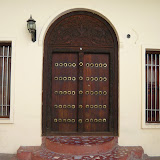
The old part of Zanzibar city, Stone Town, is completely unlike Dar es-Salaam. It's Lion King meets Aladdin. Having been ruled by Omanian sultans and as a once focal point for the slave trade between East Africa and the Middle East, Zanzibar has a unique character heavily mixing Arab influences with Swahili culture. The Arab influences are most clearly visible in the local architecture, in particular the town's famous carved doors. Stone Town itself is a maze of little streets in which you will inevitable get lost. Not that that matters as each alley way brings its own charm and sooner or later you are bound to end up somewhere familiar again. To be fair, it is quite touristy here and at times it feels like the whole town is just one big curio shop but the atmosphere is wonderful nonetheless. The fact that it is right on the deep blue waters of the Indian Ocean certainly does not do it any harm either.

Doors of Stone Town, Zanzibar

To my sheer unadulterated pleasure my hotel was also one of the cutest little boutique hotels I have ever had the good fortune of staying in. No insomnia this time in a beautiful 4-poster bed surrounded by netting and lush pillows. Mixed with a wonderful dinner and the sun on my face I have had an unbelievably relaxing weekend. Zanzibar also has some magnificent sandy beaches and reputedly is a paradise for water enthusiasts. I wish I could give you a firsthand account of all that too but a weekend is simply not enough to experience all the island has to offer. Tanzania on the whole is too big and interesting a country to be done in weekends and forgotten hours. It is a good thing then that I will have to come back here. If I can manage at all at any point I will certainly try to add on some holidays.

Friday, August 22, 2008

International Wait

Don't get me wrong, I love getting the chance to work in places such as Ghana, Russia or Tanzania, but it does come with a few downsides too. The part of the job that really clashes with my fairly gung-ho nature is the endless waiting and excruciating slowness of everything. My idea of a useful visit is to go in, do my thing as efficiently as possible, maybe relax a bit and come out. The reality is more go in, wait a while, do a little bit, wait some more, do another bit, wait again and finally agree to "follow up soon". Especially where procedures and bureaucracy are involved it is just the nature of the game called International Aid (IA). Since I work in academia still rather than directly for an NGO, I know I have even only experienced the tip of the iceberg. Many NGOs are renowned for their syrupy procedures and tortoise-like velocity.

You may think that waiting is not such a bad thing if you get to spend time in exotic places but unfortunately that is not quite how it works. Since you never know when things suddenly will kick into action you have to remain on standby, pretty much confining you to the hotel. Perhaps that is why IA workers tend to be found in the most expensive hotels in town. Giles Bolton in his book Poor Story refers to this group somewhat cynically as the "345ers", for their:
  • 3 course meals
  • 4 wheel drives
  • 5 star hotels
It's not entirely fair of course as it suggests that IA people are pampered out-of-touch little princes and princesses but neither is it wholly untrue. As those of you who know me will be aware, the 3 course meal is hardly my thing anyway and though my current hotel has a pool, it does not exactly qualify as 5 star. I did, however, yesterday have dinner in what is easily the fanciest hotel in town and, for sure, there they were: the IA conference delegates rubbing shoulders with attendees of the ministerial meeting next door. The 4-wheel drives on the other hand are spot on even for me. So far, in almost all places I have been, I find myself being picked up by these high-wheeled monsters with all sorts of important looking logos encrusted on their doors.

So here I am again: waiting in my hotel room for the 4-wheel drive to come and pick me up to do my bit for today. Bit by tiny little bit we are moving forwards but by now it is already clear that I will have to come back here pretty soon to do that infamous follow-up. By the looks of things, I may not get to spend much time in that longed for Amsterdam apartment of mine after all!

Sunday, August 17, 2008

Time out in Tanzania

Just like I had hoped I have been able to recharge my batteries very nicely this weekend. Although I worked a bit in the mornings, I have had the afternoons and evenings to relax and enjoy. In the end I did not go to the beaches, which proved a bit more difficult to reach in a limited space of time, but I certainly managed to take full advantage of the hotel swimming pool. Ocean view lunches and tasty dinners are definitely not a bad way to spend time either. My, it's a hard life!

The mystery of Dar Es-Salaam's apparent well-off state is beginning to unravel a bit. As I suspected, the neighbourhoods we have come through are not entirely representative. Dar is a rather schizophrenic place. Along the ocean front there are some very, very posh looking villas. These mainly belong to diplomats and other well-to-do expats. Then there is the old colonial part of town which is around where I am staying. Here the streets are all paved and surprisingly clean. Much cleaner than your run of the mill London street in fact. Houses are decently looking and often brightly coloured. Aside from the frequent power outages and water shortages it strikes me as really not such a bad place to be. This part of town and the neighbouring areas are not populated by African Tanzanians either though. This is little India. Eastern Africa has a fairly large population of Indians, mostly as a result of the former British colonial rule. The Indians are in general far better off than their African counterparts. They are the entrepreneurs running the corner shops and small businesses.

The African part of town is clearly less developed although visibly new buildings have sprouted up left and right. You can see the direction the town is headed but there is still a long way to go. The upshoot of new middle-class type houses does, however, make you wonder what happened to the people who used to live in these areas. Given that Tanzania is still a very poor country it is unlikely that the once poor have en masse joined the middle classes. Rather, the poor have been pushed further out of the centre to the slum parts of town, out of sight.

Despite these large discrepencies I still think Dar has a fairly pleasant feel to it. Unfortunately, it is also rather dull. Compared to the chaos in Accra, Dar is incredibly sleepy. In the evenings the roads are deserted and it doesn't feel like there is much to do around. This may be the capital but there is not much more going on than in most European country side villages. Tomorrow I will be travelling for the day into one of the nearby districts. I suspect this may give me a truer flavour of what the country is really like. So much for the relaxation; tomorrow works starts again!

Friday, August 15, 2008

Karibu!

On Sunday I was still breathing in the fresh Norwegian mountain air. Today I am inhaling diesel fumes in Dar Es-Salaam. I’ve arrived early this morning after an exhausting overnight flight. I seem to have picked up a touch of insomnia lately and my body is protesting in all sorts of ways against the less than 2 hours of sleep it has been getting in the last 48 hours. Especially since I already started working within hours after stepping off the plane. My interview techniques were definitely a bit blunted today by sleep deprivation so it is a good thing I will have all weekend to recover and prepare.

First impressions of Tanzania then… Not as hot as I was expecting at all. In fact, it has been raining down quite spectacularly for part of today. Day temperatures are pleasantly below 30 degrees. I may not have seen quite enough of the town to fully warrant this judgment but so far Dar Es-Salaam strikes me as a bit more modernised than Accra. Buildings look newer and cleaner, traffic is still chaotic but somewhat less suicidal, and poverty is not as blatantly in your face. Then again, according to the Economist’s latest figures for the Human Development Index Tanzania is worse off than Ghana so probably my comparison applies to the respective capitals only. Also, I may just have seen the better parts of town so far.

I have already glimpsed the ocean but have not really seen a beach. For that you need to get a little bit further out of town. I might try to drag myself over there this weekend. I haven’t read my guidebook well enough yet to map out exactly how I want to spend my free time. For next weekend though I am considering making the crossing to Zanzibar. It is not that far and it sounds like it is definitely worth the trip. I really wish I had time to go further land inwards where the big game reserves and national parks are as well. My guidebook has mouth watering pictures of all there is to see and do there and it’s a crying shame I will not be able to do any of that as I need to be back in London before the end of the month. Perhaps next time my boss ships me off to Tanzania (a by no means hypothetical scenario in fact!) I will be able to get in a few days to roam wild. But before I visit any other countries I am dying to visit that most exotic of places: Dreamland.

Thursday, August 07, 2008

Parting is such sweet sorrow

Good night, good night! Parting is such sweet sorrow,
That I shall say good night till it be morrow. [from: Romeo & Juliet, W. Shakespeare]
Up until a week or two ago I had mostly just been excited about the prospect of moving back home soon. However, although I am still just under a month away from leaving behind the Big Smoke, my hectic travel itinerary for August means that I effectively have only a handful of days left in London, and thus I have had to start saying my goodbyes to a lot of people with a heavy heart.

Over the last two weeks I have said auf wiedersehen to a number of dear friends at occasions that more often than not involved bottles of champagne. Unfortunately, the relative suddenness with which everything has unfolded has meant that I haven't even been able to wave adieu at everybody in person. I hope to be able to make this up by visiting London soon again. Even at work I have yesterday packed up my desk, handed in my key card and said my so longs . The office is in fact getting very empty as the ripple effect from my boss' decision has been a mass migration to greener pastures. Come September there will only be a handful of people left.

I have arrived in Norway late last night and will be enjoying a short holiday here for a few days. As we are moving further up North this evening I will actually find myself completely cut off from work, unable to answer any emails. Given the flurry of those that I sent and received in the last few days, trying to get all my ducks in a row, that will be unnerving and cathartic at the same time. Time to let go, at least for a couple of days.